
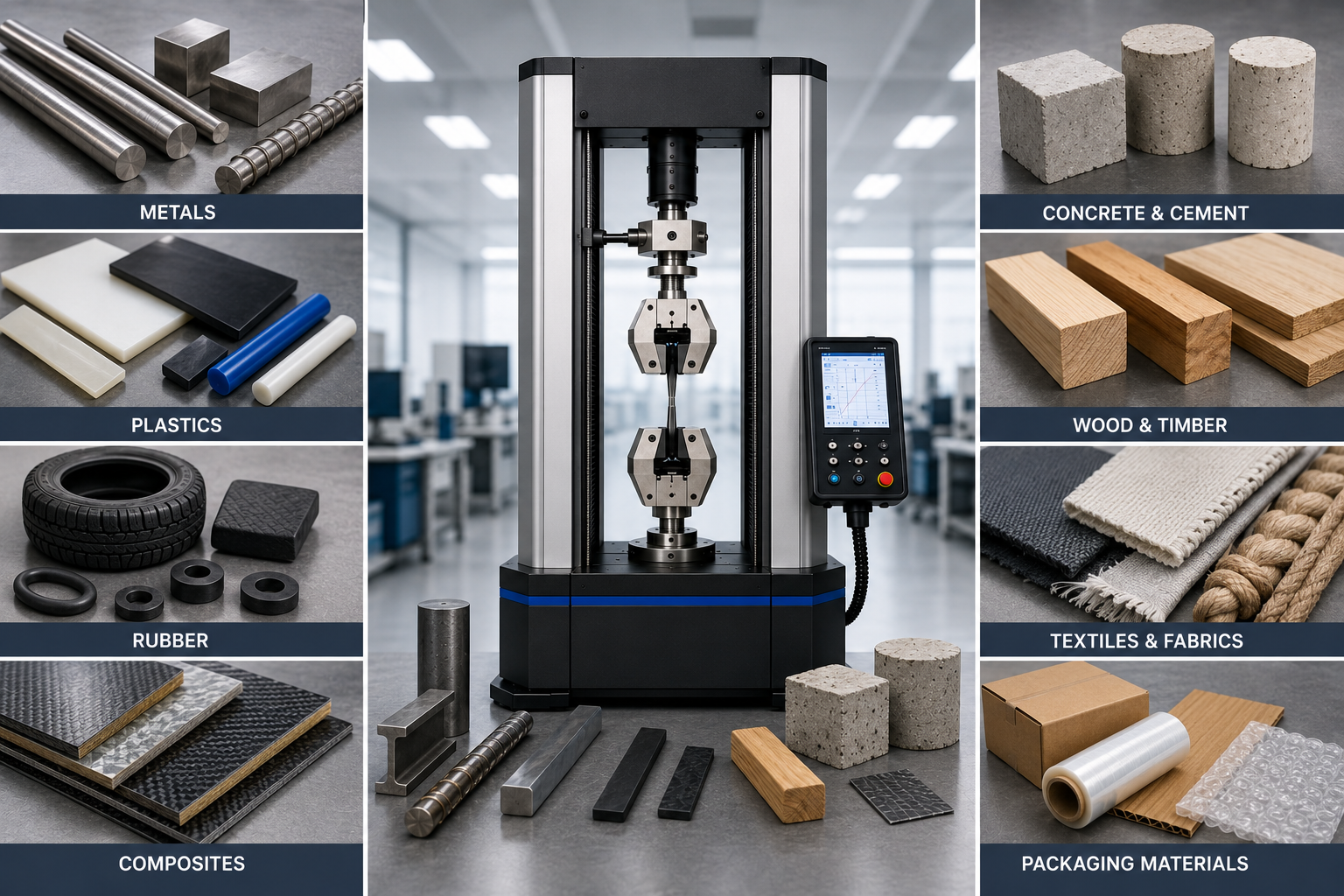
Universal Testing Machines (UTMs) are among the most versatile testing systems used in modern industries, laboratories, and research institutions. Their ability to perform multiple testing methods, including tensile, compression, bending, shear, and flexural testing, makes them suitable for evaluating a wide variety of materials. Material testing is essential because the performance, strength, durability, and safety of a product largely depend on the properties of the materials used in its construction. By accurately measuring how different materials behave under applied loads, Universal Testing Machines help manufacturers maintain quality standards, improve product performance, and ensure compliance with industry requirements.
One of the most commonly tested materials using a Universal Testing Machine is metal. Metals are widely used in industries such as construction, automotive manufacturing, aerospace engineering, machinery production, and infrastructure development. Steel, stainless steel, aluminum, copper, brass, and various metal alloys undergo tensile and compression testing to determine their mechanical properties. Engineers use these tests to evaluate tensile strength, yield strength, elongation, ductility, and overall structural performance. The information obtained through testing helps manufacturers select the right materials for specific applications and ensure that metal components can withstand operational loads without failure.
Steel is particularly important in material testing due to its extensive use in structural applications. Reinforcement bars, steel rods, beams, plates, wires, and fabricated components are regularly tested using Universal Testing Machines. These tests help verify compliance with engineering specifications and construction standards. Accurate steel testing contributes to safer buildings, bridges, industrial structures, and transportation systems by ensuring that materials possess the required strength and reliability.
Plastic materials are another major category commonly tested using Universal Testing Machines. Modern industries rely heavily on plastics because of their lightweight properties, versatility, and cost-effectiveness. Plastic products are used in packaging, consumer goods, automotive components, medical devices, electrical equipment, and industrial applications. Different plastic materials exhibit varying levels of flexibility, strength, and resistance to deformation. UTM testing helps manufacturers determine tensile strength, elongation, stiffness, and fracture characteristics. These results support product development, quality assurance, and material selection processes while helping companies optimize product performance.
Rubber and elastomeric materials are also frequently evaluated using Universal Testing Machines. These materials are commonly found in seals, gaskets, tires, belts, hoses, footwear products, and numerous industrial applications. Because rubber materials experience significant stretching and deformation during use, tensile testing plays a critical role in evaluating their performance. Universal Testing Machines help determine elasticity, elongation properties, tear resistance, and tensile strength, allowing manufacturers to ensure that rubber products maintain their functionality under demanding conditions.
Composite materials have become increasingly popular across industries due to their high strength-to-weight ratio and excellent performance characteristics. Aerospace, automotive, marine, and sporting goods manufacturers often use advanced composites to reduce weight while maintaining structural integrity. Universal Testing Machines are used to evaluate the mechanical properties of composite materials, including tensile strength, compression resistance, flexural strength, and interlaminar performance. Accurate testing helps engineers understand how composite structures behave under load and supports the development of innovative, high-performance products.
The construction industry relies heavily on Universal Testing Machines to evaluate concrete and cement-based materials. Concrete is one of the most widely used construction materials in the world, and its strength directly impacts the safety and durability of structures. Compression testing is commonly performed on concrete cubes, cylinders, and blocks to determine compressive strength and load-bearing capacity. Cement products, paving materials, and construction components also undergo testing to ensure compliance with engineering specifications and building standards.
Wood and timber products are another category of materials commonly tested using Universal Testing Machines. Wood is widely used in construction, furniture manufacturing, packaging, and decorative applications. Mechanical testing helps determine properties such as tensile strength, compression resistance, bending performance, and load-bearing capacity. These evaluations are particularly important when wood products are intended for structural or heavy-duty applications where safety and durability are critical considerations.
Textile and fabric manufacturers also utilize Universal Testing Machines to evaluate the strength and durability of their products. Fabrics, ropes, safety belts, industrial textiles, protective clothing, and geotextile materials must often withstand significant mechanical stresses during use. Tensile testing helps determine breaking strength, elongation characteristics, and overall material performance. These tests allow manufacturers to verify product quality and ensure that materials meet customer and industry requirements.
Packaging materials are regularly tested using Universal Testing Machines as well. Cardboard boxes, plastic films, paper products, corrugated packaging, and protective materials must be capable of resisting forces encountered during transportation, storage, and handling. Compression, tensile, and puncture resistance tests help manufacturers evaluate packaging performance and improve product protection. Effective packaging testing contributes to reduced product damage and enhanced supply chain efficiency.
As technology advances and industries continue to develop new materials, the importance of Universal Testing Machines continues to grow. Their ability to evaluate a diverse range of materials makes them indispensable for quality control, research, product development, and regulatory compliance. Whether testing metals, plastics, rubber, composites, concrete, wood, textiles, or packaging materials, Universal Testing Machines provide the accurate data needed to assess material performance and ensure product reliability. By supporting informed decision-making and continuous improvement efforts, these machines play a vital role in helping organizations deliver safer, stronger, and higher-quality products across a wide range of industries.