
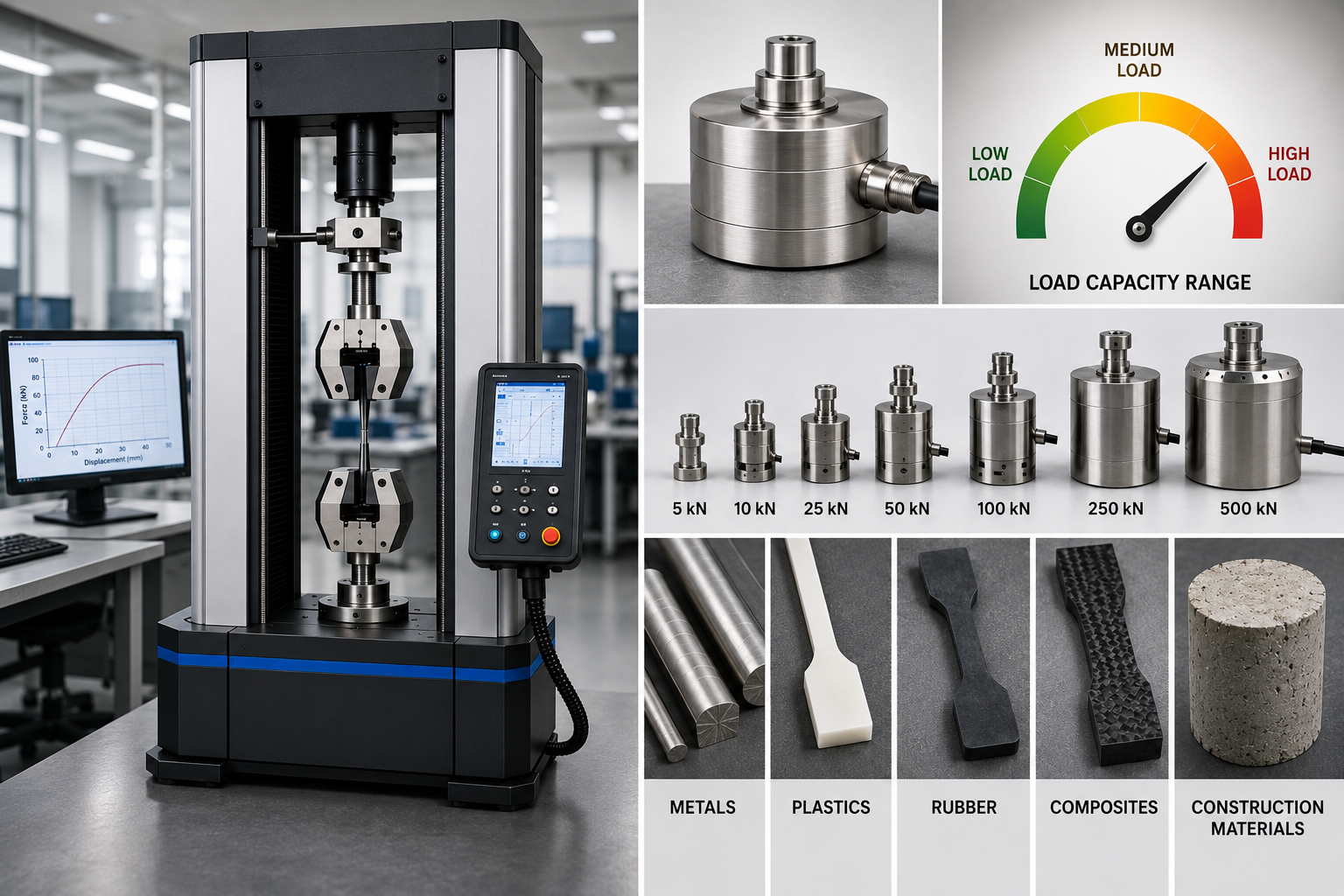
Load capacity is one of the most important factors to consider when selecting or operating a Universal Testing Machine (UTM). It directly influences the machine’s ability to accurately measure and evaluate the mechanical properties of various materials. Whether a company is testing metals, plastics, rubber, composites, construction materials, or finished products, understanding load capacity is essential for obtaining reliable testing results and ensuring that the machine performs efficiently. A Universal Testing Machine may offer advanced features and sophisticated software, but if its load capacity does not match the testing requirements, the accuracy and effectiveness of the testing process can be significantly affected.
In simple terms, load capacity refers to the maximum force that a Universal Testing Machine can safely apply and measure during a testing procedure. This force is typically expressed in units such as kilonewtons (kN), tonnes, or pounds-force depending on regional standards and machine specifications. Different UTM models are designed to handle different load ranges, allowing them to accommodate a wide variety of testing applications. Small laboratory machines may be suitable for testing plastics, rubber, textiles, and lightweight materials, while larger industrial systems are capable of evaluating heavy-duty metals, structural components, and construction materials that require significantly higher testing forces.
The importance of selecting the correct load capacity becomes evident when considering testing accuracy. Every Universal Testing Machine is designed to operate most accurately within a specific range of its total capacity. If a machine with a very high load capacity is used to test extremely small specimens, the measurement sensitivity may be reduced, potentially affecting result precision. Conversely, attempting to test materials that exceed the machine’s rated capacity can overload the system, damage critical components, and compromise safety. Therefore, selecting an appropriate load range is critical for both performance and reliability.
Load capacity plays a major role in determining the types of materials that can be tested effectively. For example, plastic films, packaging materials, rubber specimens, and textile products generally require lower testing forces and can be evaluated using lower-capacity machines. On the other hand, steel bars, structural components, construction materials, and heavy-duty industrial products often require high-capacity UTMs capable of generating substantial forces. Understanding the expected load requirements of the materials being tested helps organizations choose equipment that aligns with their operational needs.
Another important factor related to load capacity is the load cell, which serves as the primary force-measuring component of the Universal Testing Machine. The load cell converts applied force into measurable electronic signals that are processed by the machine’s control system. Different load cells are available for different force ranges, and many modern UTMs allow operators to interchange load cells based on testing requirements. This flexibility improves measurement accuracy and enables a single machine to perform a broader range of testing applications. Choosing the appropriate load cell for each test ensures optimal performance and enhances data reliability.
In manufacturing and quality control environments, load capacity influences testing efficiency and productivity. Organizations that work with multiple material types often require testing systems capable of handling a wide range of loads. Selecting a machine with sufficient capacity allows manufacturers to accommodate future product developments and changing testing requirements without investing in additional equipment. This scalability makes load capacity an important consideration for long-term operational planning and cost management.
Load capacity also affects machine design and construction. Higher-capacity Universal Testing Machines typically feature stronger frames, larger crossheads, more powerful drive systems, and reinforced testing fixtures. These structural enhancements ensure that the machine can safely generate and withstand the forces required for demanding applications. Industrial-grade machines designed for heavy-duty testing often incorporate advanced safety mechanisms to protect operators and equipment during high-force testing procedures.
Many industries rely heavily on proper load capacity selection to maintain quality standards and regulatory compliance. Construction companies testing reinforcement bars and concrete specimens require machines capable of handling substantial loads. Automotive manufacturers use UTMs to evaluate components that experience significant forces during operation. Aerospace organizations test advanced materials that must perform under extreme conditions. In each case, selecting the appropriate load capacity ensures that testing results accurately reflect real-world performance requirements.
Modern Universal Testing Machines often incorporate intelligent software systems that assist users in managing load capacity and testing parameters. These systems provide real-time monitoring, automatic overload protection, and advanced reporting capabilities that help operators conduct tests safely and efficiently. Automated controls also reduce the risk of human error and contribute to more consistent testing outcomes. By combining suitable load capacity with advanced digital technologies, organizations can achieve greater testing accuracy and operational efficiency.
Understanding load capacity is essential for anyone involved in material testing, quality assurance, research, or product development. It influences testing accuracy, equipment performance, safety, and long-term operational flexibility. Selecting a Universal Testing Machine with the appropriate load capacity ensures that materials can be evaluated effectively while maintaining reliable and repeatable results. As industries continue to demand higher quality standards and more sophisticated testing capabilities, load capacity remains one of the most critical considerations when choosing and operating a Universal Testing Machine. By making informed decisions regarding load requirements, organizations can maximize equipment performance, improve product quality, and support long-term business success.