
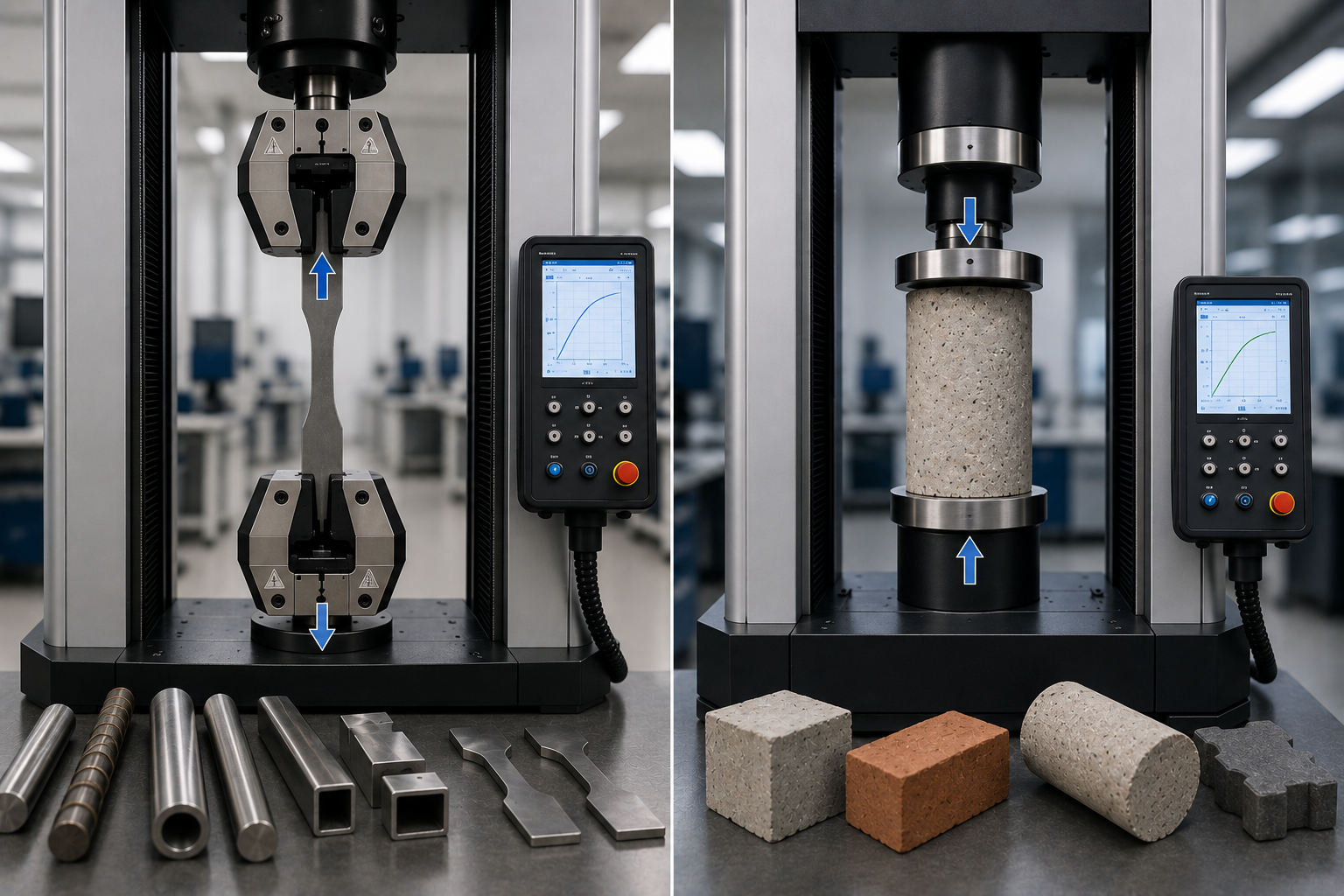
Material testing plays a crucial role in determining the strength, durability, and overall performance of engineering materials. Among the various testing methods used across industries, tensile testing and compression testing are two of the most common and important procedures. Both tests are performed using a Universal Testing Machine (UTM) and are designed to evaluate how materials behave under different loading conditions. While both methods help engineers understand material properties, they serve different purposes and provide different types of information. Understanding the differences between tensile testing and compression testing is essential for selecting the right testing method based on the intended application of the material.
Tensile testing is a method used to determine how a material behaves when subjected to pulling forces. During the test, a specimen is gripped at both ends and gradually stretched until it deforms or ultimately breaks. As the load increases, the Universal Testing Machine continuously measures the force applied and the amount of elongation experienced by the specimen. This process allows engineers to evaluate important mechanical properties such as tensile strength, yield strength, elongation, ductility, and modulus of elasticity. Tensile testing is widely used for metals, plastics, wires, textiles, composites, and various engineering materials where resistance to pulling forces is a critical requirement.
Compression testing, on the other hand, evaluates how a material performs when subjected to pushing or crushing forces. In this test, the specimen is placed between compression platens, and force is applied until the material deforms, cracks, or reaches a predetermined load level. The objective is to measure the material’s ability to withstand compressive loads without failure. Compression testing is commonly used for concrete, cement products, bricks, ceramics, packaging materials, foams, and structural components that are expected to endure compressive stresses during service. The test helps determine compressive strength, deformation characteristics, and load-bearing capacity.
One of the primary differences between tensile and compression testing lies in the direction of the applied force. Tensile testing pulls the material apart, while compression testing pushes the material together. Because materials often behave differently under tension and compression, both tests provide unique insights into material performance. Some materials may exhibit excellent tensile strength but relatively low compression resistance, while others may perform exceptionally well under compression but poorly under tension. Understanding these differences helps engineers select the most appropriate materials for specific applications.
The type of failure observed during each test also differs significantly. In tensile testing, materials typically fail through stretching, necking, and eventual fracture. The failure pattern provides valuable information about ductility, brittleness, and overall material behavior. In compression testing, failure may occur through crushing, cracking, buckling, or permanent deformation depending on the material type. Observing how a material fails under different loading conditions helps engineers evaluate its suitability for real-world applications and identify potential performance limitations.
Tensile testing is especially important in industries where materials are exposed to pulling forces during operation. Automotive components, cables, structural steel members, fasteners, aircraft parts, and polymer products often undergo tensile testing to verify their performance under tension. The results help manufacturers ensure that materials can safely withstand operational loads without unexpected failure. Tensile testing also plays a critical role in product development, material comparison, and quality assurance programs across numerous industries.
Compression testing is particularly important for construction and infrastructure applications. Materials such as concrete blocks, cement cubes, paving materials, structural components, and packaging products must demonstrate sufficient compression strength before being approved for use. Engineers rely on compression testing results to ensure that buildings, bridges, roads, and industrial structures can safely support anticipated loads throughout their service life. Accurate compression testing contributes directly to structural safety, reliability, and regulatory compliance.
Both tensile and compression testing generate valuable data that can be displayed using stress-strain curves. These graphs illustrate how materials respond to applied loads and help engineers identify key performance characteristics. By analyzing stress-strain relationships, professionals can compare materials, optimize product designs, and make informed decisions regarding material selection. Modern Universal Testing Machines use advanced software to automatically generate these graphs and provide detailed reports for quality control and documentation purposes.
The choice between tensile testing and compression testing depends largely on the intended use of the material. If a material will primarily experience pulling forces during service, tensile testing becomes the preferred evaluation method. If the material is expected to bear compressive loads, compression testing is more appropriate. In many cases, manufacturers perform both tests to obtain a complete understanding of material behavior and ensure comprehensive performance evaluation. This approach helps improve product reliability, reduce risks, and maintain consistent quality standards.
As industries continue to demand higher levels of performance and safety, both tensile testing and compression testing remain essential tools in modern material evaluation. Together, these testing methods provide critical insights into how materials respond under different loading conditions and help organizations develop stronger, safer, and more reliable products. By understanding the key differences between tensile testing and compression testing, engineers and manufacturers can make better decisions regarding material selection, product development, and quality assurance, ultimately contributing to improved performance and long-term success.