Selecting the right Universal Testing Machine (UTM) is one of the most important decisions for organizations involved in manufacturing, quality control, research, product development, and material testing. A Universal Testing Machine is a long-term investment that directly impacts testing accuracy, operational efficiency, product quality, and compliance with industry standards. With numerous machine types, load capacities, testing features, and software options available in the market, choosing the most suitable UTM requires careful consideration of both current and future testing requirements. Understanding the key factors involved in the selection process can help businesses make informed decisions and maximize the value of their investment.
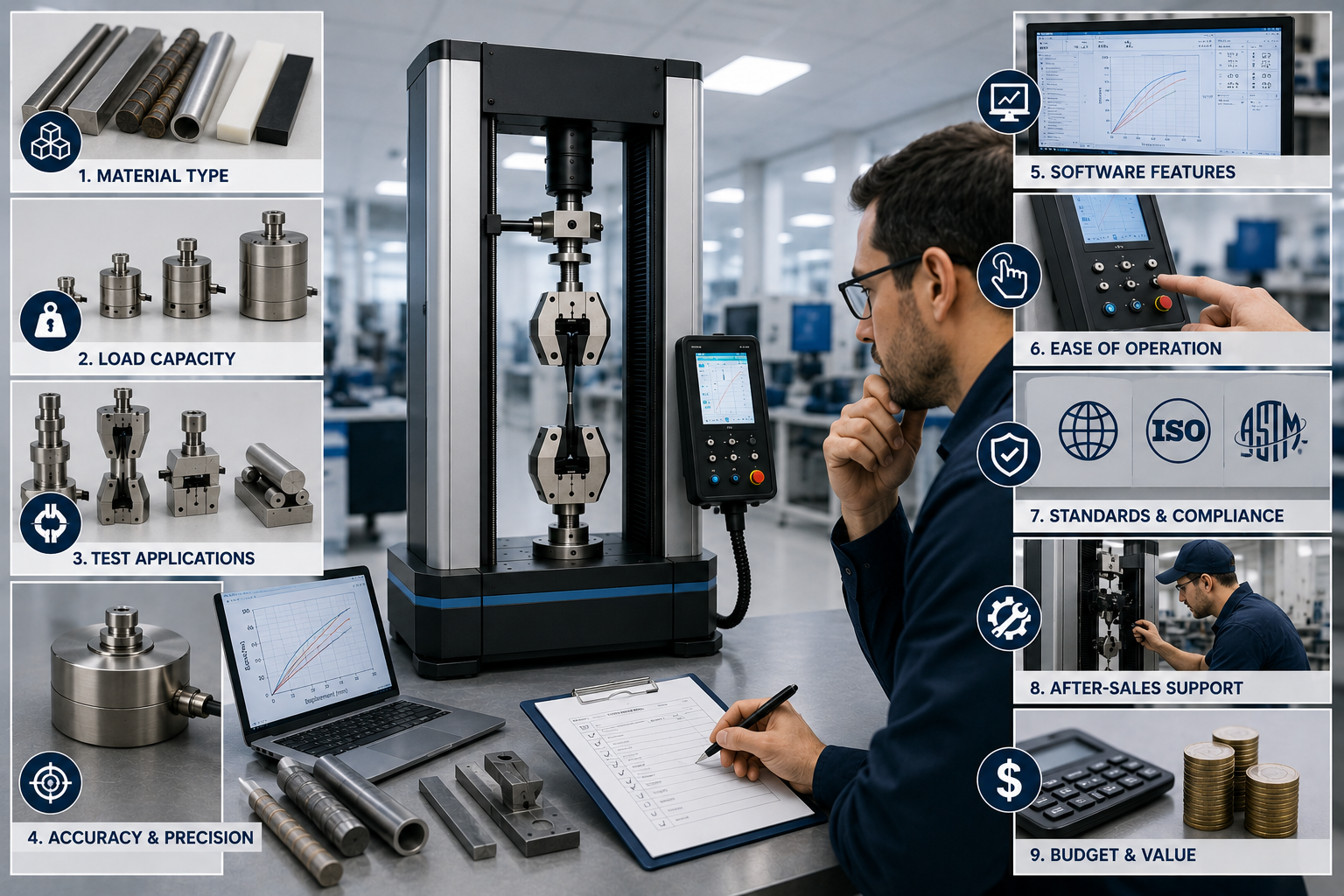
The first factor to consider when choosing a Universal Testing Machine is the type of material that will be tested. Different industries work with different materials such as metals, plastics, rubber, composites, textiles, concrete, and construction products. Each material has unique testing requirements and mechanical characteristics. A machine selected for testing metal components may differ significantly from one intended for testing plastics or packaging materials. Identifying the primary materials to be tested helps determine the appropriate machine configuration, load capacity, grips, fixtures, and software capabilities required for accurate testing.
Load capacity is another critical consideration during the selection process. Universal Testing Machines are available in various load ranges designed to accommodate different applications. Choosing a machine with insufficient load capacity can limit testing capabilities, while selecting an oversized machine may result in unnecessary costs and reduced measurement sensitivity for smaller specimens. Businesses should evaluate the maximum force expected during testing and select a machine that provides sufficient capacity while maintaining high accuracy throughout the testing range. It is often advisable to account for future testing requirements to ensure long-term flexibility.
The type of testing applications to be performed also plays a major role in machine selection. Some organizations primarily conduct tensile testing, while others may require compression, bend, shear, peel, tear, or flexural testing. Modern Universal Testing Machines can perform multiple testing methods using interchangeable fixtures and accessories. Companies should carefully assess their testing objectives and ensure that the selected machine can support all required applications. A versatile testing system provides greater operational flexibility and allows businesses to expand their testing capabilities as requirements evolve.
Accuracy and precision are essential factors for any material testing operation. The quality of testing results directly influences product development decisions, quality control processes, and compliance activities. Businesses should choose a Universal Testing Machine that offers reliable load measurement, precise displacement control, and consistent data acquisition capabilities. High-quality load cells, advanced sensors, and modern control systems contribute significantly to testing accuracy and repeatability. Investing in a machine with proven measurement performance helps ensure dependable and trustworthy results.
Software capabilities have become increasingly important in modern material testing environments. Advanced testing software allows operators to create customized testing procedures, monitor tests in real time, generate detailed reports, analyze data, and maintain comprehensive testing records. User-friendly software improves productivity and reduces the likelihood of operator errors. Businesses should evaluate software functionality, reporting features, data storage capabilities, and compatibility with existing quality management systems before making a purchase decision. A powerful software platform can greatly enhance overall testing efficiency and simplify regulatory compliance.
Ease of operation is another factor that should not be overlooked. Testing equipment is often used by multiple operators with varying levels of experience. A machine with intuitive controls, clear interfaces, automated functions, and simplified testing workflows can improve productivity and reduce training requirements. Easy-to-use systems help minimize operational errors and ensure consistent testing procedures across different users. Organizations should consider operator comfort and workflow efficiency when evaluating potential equipment options.
Industry standards and compliance requirements must also be taken into account during the selection process. Many industries operate under strict quality regulations and testing standards established by national and international organizations. The selected Universal Testing Machine should be capable of performing tests according to applicable standards and generating documentation that supports compliance efforts. Machines designed to meet recognized testing standards provide greater confidence in the validity and acceptance of test results across different markets and applications.
Long-term reliability and after-sales support are equally important when investing in a Universal Testing Machine. Even the most advanced testing equipment requires periodic maintenance, calibration, technical support, and occasional replacement parts. Businesses should evaluate the reputation of the manufacturer or supplier, availability of technical assistance, service response times, and support infrastructure before making a final decision. Reliable after-sales service helps minimize downtime and ensures that the machine continues to operate at peak performance throughout its lifespan.
Budget considerations naturally influence the purchasing process, but organizations should focus on overall value rather than simply selecting the lowest-cost option. A high-quality Universal Testing Machine may involve a larger initial investment but can deliver significant long-term benefits through improved accuracy, durability, operational efficiency, and reduced maintenance costs. Businesses should evaluate the total cost of ownership, including software, accessories, calibration services, training, and future expansion possibilities when comparing different systems.
Choosing the right Universal Testing Machine ultimately requires a careful assessment of testing requirements, material types, load capacities, software features, compliance needs, and long-term business objectives. A well-selected machine not only improves testing accuracy and productivity but also supports product quality, customer satisfaction, and regulatory compliance. As industries continue to prioritize quality assurance and material performance evaluation, investing in the right Universal Testing Machine becomes a strategic decision that contributes directly to operational success, innovation, and long-term growth.